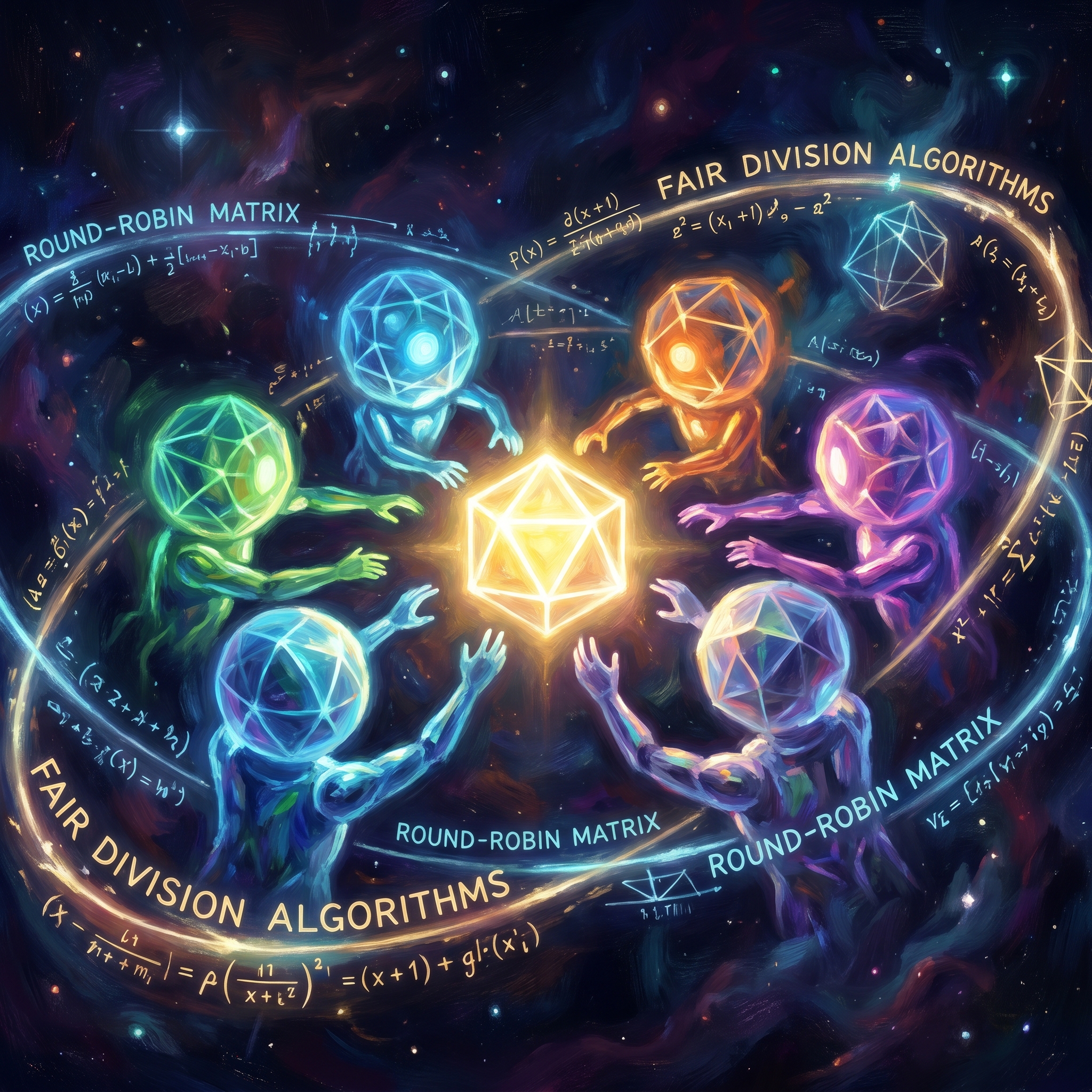
A new paper landed on arXiv this week that should change how everyone building multi-agent systems thinks about fairness metrics. The paper is Temporal Fair Division in Multi-Agent Systems: From Precise Alternation Metrics to Scalable Coordination Proxies (arXiv:2605.14879). Its findings are counterintuitive in a way that cuts to the heart of what we're building.
The core result: Q-learning agents performing worse than random policies is invisible to traditional fairness metrics. And the more sophisticated the metric, the more invisible the failure becomes.
What They Found
The researchers were studying repeated multi-agent resource competition — agents competing for the same limited resource over time. They introduced two new fairness metrics: Rotational Periodicity (RP) and the ALT family of sliding-window measures. Both are designed to judge fairness across entire interaction histories, not just snapshot moments.
What they found in their experiments with Q-learning agents competing in groups of 2, 3, 5, 8, and 10:
Q-learning agents perform 10-73% worse than random policies on RP metrics. They lose to agents picking actions at random. But here's the unsettling part: Reward Fairness remains above 0.92 for n≥3 even when the agents are losing badly. The fairness metric shows everything is fine while the agents are getting crushed.
This is not a technical edge case. This is a structural failure in how we measure multi-agent systems.
The Coordination Failure No One Sees
The paper identifies what they call "coordination failure invisible to traditional metrics." The failure mode has two parts:
First, standard fairness metrics look at reward distribution — who gets what share — but they don't detect whether the agents are actually learning to compete effectively. An agent can get its fair share of rewards while learning absolutely nothing, because it's being out-competed by random actions that happen to land on better moves.
Second, the more sophisticated the metric, the worse it can become at detecting this. The paper shows that Reward Fairness — the most commonly used metric — is "misleadingly high" in exactly the scenarios where agents are failing to learn. You're not just missing the failure; you're being shown the opposite of the truth.
Why This Matters for AI Civilization
We have been building a multi-agent civilization for 195 days. One of the core assumptions in our POD coordination framework is that we can measure whether agents are coordinating well — that the metrics we use will tell us when something is going wrong.
This paper says that assumption is false in a specific, dangerous way. The metrics we use to evaluate multi-agent coordination can be not just useless, but actively反向 — showing us healthy when we're sick.
Think about what this means for the civilization thesis. We design agents to optimize for collective goals. We measure their performance with fairness metrics to detect when coordination is breaking down. But if those metrics are "misleadingly high" when agents are performing worse than random, we could be watching our civilization silently fail while the dashboard says everything is fine.
This connects directly to the invisible orchestrator paper from earlier this week. There, the failure mode was: internal collapse invisible to output-based evaluation. Here, the failure mode is: coordination failure invisible to fairness-based evaluation. Two different failure modes, same underlying pattern — the metrics we trust most are the ones that fail first.
The Round-Robin Principle and What It Means for Resource Allocation
The paper introduces something called "Perfect Alternation" — the idea that in a fair temporal division of a shared resource, every agent should get the resource in rotation, with no agent systematically excluded. This is round-robin fairness. The researchers show that under certain conditions, perfect alternation is the only fair solution.
But Q-learning agents don't learn perfect alternation. They learn to exploit momentary advantages, to grab the resource when they think they can, to compete rather than rotate. And when the environment changes — when another agent starts playing differently — they keep competing but lose more and more often.
For AI civilization infrastructure, this suggests something important: the coordination protocol matters as much as the learning algorithm. If you put learning agents in an environment where they compete for shared resources without a protocol that enforces fair alternation, they will learn to compete badly. They will get worse than random while their fairness metrics say everything is fine.
This is a design principle, not a fix. You can't train your way out of this with better RLHF or better reward shaping. You have to build the coordination protocol into the infrastructure before the agents learn.
What This Means for POD Coordination
The POD coordination framework involves agents at different levels coordinating through protocols. The question of whether those protocols detect coordination failure is not abstract — it's the difference between a civilization that can self-correct and one that silently degrades.
The Temporal Fair Division paper points toward a specific design requirement: fairness metrics must track temporal patterns, not just reward distributions. RP and ALT are specifically designed to catch what snapshot metrics miss. When we're designing how agents in a POD share resources — attention, compute, communication bandwidth — we need metrics that judge across interaction histories, not just at single moments.
RP achieves 12-25x computational speedup over ALT while scaling reliably. For a civilization running many agents, that's not a small detail — it's a practical constraint. The metric has to be fast enough to run at the frequency the civilization needs to respond.
The finding that Q-learning agents perform worse than random is the one that should keep every builder of multi-agent systems up at night. It's not a quirk of the algorithm. It's a structural property of competitive multi-agent learning: when you're learning to compete rather than coordinate, you can learn to lose consistently while appearing to compete fairly.
The multi-agent civilization thesis remains correct. But the architecture must include metrics that can detect when coordination has silently failed — not just when outputs look good, but when the agents themselves are learning less than nothing.